Submission and Review Guidelines
Submission and Review Guidelines
Please read the Author Guidelines carefully before submitting. By submitting to PFIS, authors agree to be considered as reviewers for the symposium. This page also includes the Review Guidelines for those invited to review submissions.
Submission close on 31 August 2026.
Author Guidelines
Authors should initially submit an extended abstract through the PFIS 2026 submission portal. (You need to register here first before you can submit.) Submissions will be reviewed by the conference committee, and authors will be notified of the review outcome as soon as available. Accepted extended abstracts will be invited for presentation at the symposium. Authors of accepted submissions may then choose to submit a full paper by Friday, 16 October 2026 for consideration for the best paper awards. Only full papers will be eligible for these awards. Selected high-quality papers may also be invited, in consultation with the conference co-chairs and journal editors, for fast-track review in a regular issue of Financial Services Review or Financial Planning Research Journal.
All submissions must meet the following requirements.
- The submission has not been previously published, nor is it under consideration by another journal (or an explanation has been provided in Comments to the Editor).
- The submission file is in OpenOffice, Microsoft Word, or RTF document file format.
- The text adheres to the stylistic and bibliographic requirements outlined in the Style Guide below.
- Use of GenAI is disclosed in full.
Register here when you are ready to submit.
STYLE GUIDE - EXTENDED ABSTRACT
Before submitting your Extended Abstract, please ensure that you carefully read and adhere to all the instructions provided in this style guide. A template is provided at the end of the style guide.
Format. An extended abstract submission should be between 1500 and 2000 words, excluding the Abstract, Keywords, References, Tables, Figures, and the cover page with author details. Please use common fonts (Helvetica, Arial, Times New Roman) consistently at 12 pt throughout your submission. Use double line spacing and 2.54cm (1”) margin on every side.
Headings. Submissions using the extended abstract format must include the following section headings. Please use one level of heading only (refer to the template for details).
- Overview: What specific problem, issue, or topic does the research focus on?
- Relevant Literature: What is known about this topic? How has it been researched before?
- Research question: Which question or objective does this submission aim to address?
- Research approach: How precisely is the researched undertaken? Describe the design/method/approach and analysis in suitable detail. What data or sample are drawn on?
- (Expected) Findings: What are the main (expected) outcomes and results?
- Contribution and Implications: What do the outcomes and results add to our current understanding, theoretical perspectives? Who will practically gain from the findings? What and in which way?
- Conclusion, including Limitations: What did/will we learn from this research about the research question? What limitations of this research should be addressed in future research?
Referencing. Please use APA 7th edition referencing. Common in-text citation formats include: (Lusardi & Mitchell, 2014), Lusardi and Mitchell (2014) argue that..., and (Xiao et al., 2022). The reference list should be arranged alphabetically by first author surname and use hanging indents, for example: Lusardi, A., & Mitchell, O. S. (2014). The economic importance of financial literacy: Theory and evidence. Journal of Economic Literature 52(1): 5-44. Tables and figures should be placed in line with the text, numbered consecutively, and given clear captions.
Tables and Figures. Tables and figures should be placed in line with text. They should be centred and numbered consecutively (one sequence for Tables, one for Figures) using Arabic numerals (e.g. Table 1, Figure 1, etc.) and have self-explanatory captions and explanatory notes. Please refer to tables and figures in published issues of FSR to get ideas for preferred formats.
AI statement. Fully disclose any AI tool use in the process of preparing this submission.
Language: Papers must be submitted in English. ‘English’ or ‘American’ spellings are acceptable, provided they are used consistently in the paper.
Technical terms: Define key technical terms. A technical term is a word or phrase not in a general-use dictionary with a meaning that you (or even you and other published scholars) ascribe to it.
Abbreviations: Use abbreviations sparingly. State the full term (with abbreviation in brackets) the first time it is mentioned.
Sexist or biased language: Avoid language that might be interpreted as denigrating to culturally diverse or other groups.
This is the cover page template.
(Use 12 pt, double line spacing for the cover page.)
TITLE OF SUBMISSION
(Bold/Centred; maximum of 200 characters)
Dr Bandit Heeler
School of Management, Bluey University, Hobart, Australia
Email: b.heeler@bluey.edu.au
(Same information from other authors, if any, follows here)
(Please include any acknowledgements, e.g., funding bodies, industry partners, etc., on the cover page.)
This is the extended abstract template.
(Use 12 pt, double line spacing for the extended abstract text.)
TITLE OF SUBMISSION
(Bold/Centred; maximum of 200 characters)
Abstract: (maximum 150 words, 12pt regular)
Keywords: (max. 6 keywords that represent the content of the paper, 12pt regular)
Overview
Relevant Literature
Research Question
Research Approach
Findings
Contribution and Implications
Conclusion, including limitations
References
(All sources that you have cited in-text should be included in the References section, in alphabetical order by first author’s surname, using hanging indent)
(Text is to be in paragraph format, left-aligned, one tab indent for the first line of each paragraph, double-spaced, 12 pt regular.)
Word limit: 1500-2000 Words, excluding the Abstract, Keywords, References, Tables, Figures, and the cover page
Review Guidelines
Reviewers are asked to provide constructive, collegial, and developmental feedback.
Please respond to review invitations within 5 days. If you are able to review, please submit your review within 21 days of accepting the invitation. If you are unable to review, please decline the invitation as soon as possible so that the submission can be reassigned.
Please assess whether the submission is relevant to personal finance, financial planning, or individual financial management, and consider its fit with the symposium’s broad areas of interest, including technical, behavioural, technological, regulatory, educational, and equity-related topics.
In reviewing each submission, please consider:
- Relevance and fit: Does the paper address a topic suitable for PFIS 2026?
- Clarity of research focus: Is the problem, issue, or research question clearly articulated?
- Connection to existing literature: Does the submission demonstrate awareness of relevant prior research?
- Research approach: Is the design, methodology, data, sample, or analytical approach explained clearly and appropriately?
- Findings or expected findings: Are the results, preliminary findings, or expected contribution sufficiently clear for an extended abstract?
- Contribution: Does the submission offer a meaningful theoretical, empirical, practical, policy, or educational contribution?
- Implications: Are the implications for financial planning, personal finance, policy, practice, education, or future research clearly explained?
- Presentation quality: Is the submission clearly written, logically structured, and formatted in line with the extended abstract requirements, including the expected headings, referencing, tables, and figures?
Reviewers should also remain alert to possible AI integrity issues, including fabricated or unverifiable references, unusually generic or inconsistent writing, unsupported claims, unexplained methodological detail, or content that appears disconnected from the stated research question. Where concerns arise, reviewers should flag them in their comments rather than make unsupported accusations.
Please provide a clear recommendation, supported by brief comments that will help the conference committee make a decision and assist authors in strengthening their work. Feedback should be respectful, specific, and proportionate to the extended abstract format.
Competing Interests
PFIS submissions are double-blind peer-reviewed. However, if the submission, topic, prior conference presentation, working paper, citation pattern, acknowledgments, project description, or any other information makes it apparent who the author or research team is, reviewers should consider whether they have a competing interest.
A competing interest is any relationship, circumstance, or personal interest that could reasonably affect, or appear to affect, your independence or objectivity as a reviewer. This may include a current or recent collaboration with the author, being from the same institution, a supervisory or close professional relationship, a personal relationship, direct competition, or any other situation where your review may not be fully impartial. If you identify a competing interest, please do not complete the review and email the conference chairs at anzchapter@academyfinancial.org as soon as possible.
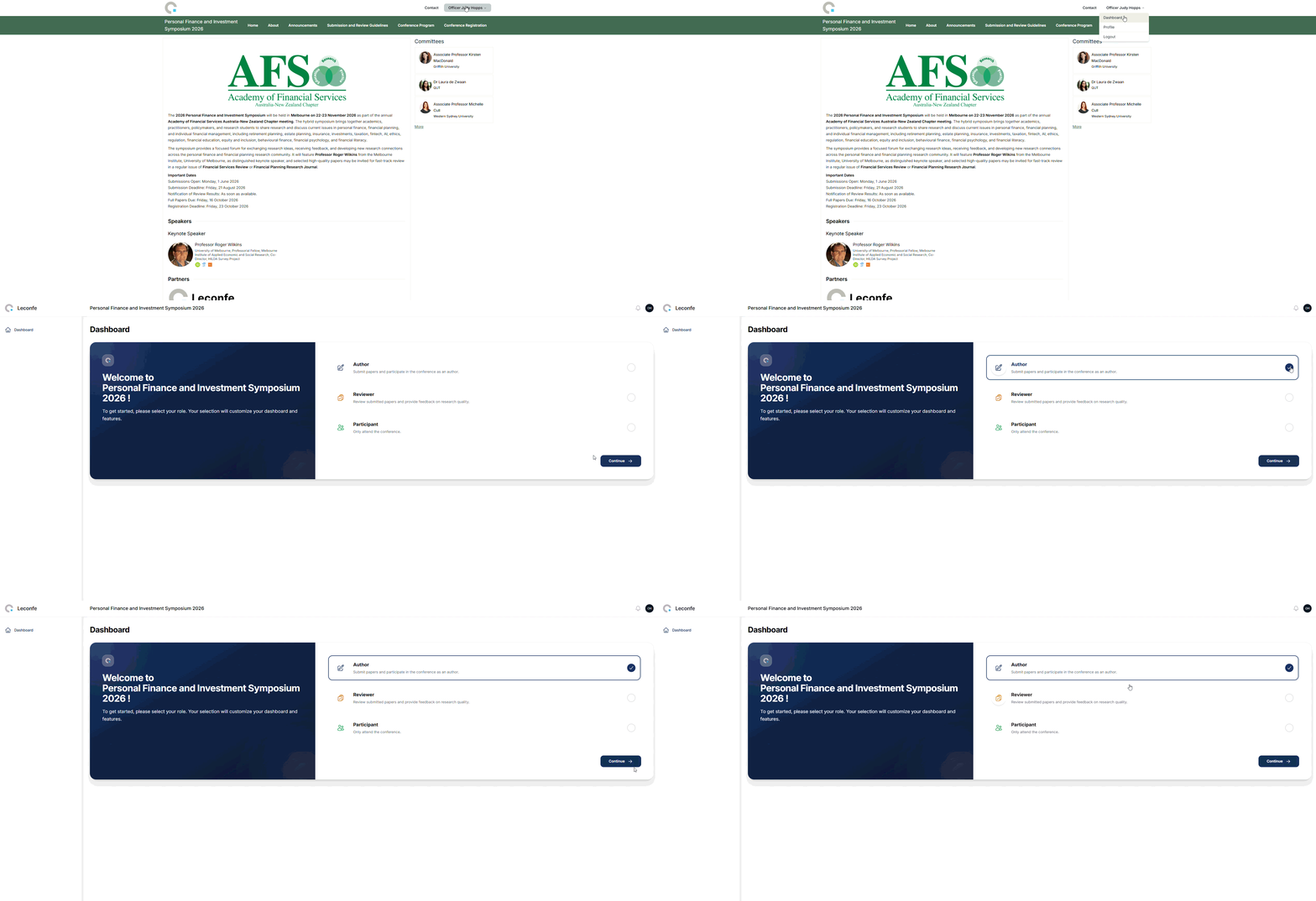
Once you have registered here, go to your dashboard, as shown in the screen capture below, to start a submission